Skylight Leak Repair in Greenville, SC
A skylight is a hole deliberately cut through a roof. It works when the flashing around it is built correctly, and it leaks when it is not — which is why skylight leaks are so often an installation problem rather than a product problem.
Greenville SC Roofing Pros connects you with an independent local roofing contractor. We do not carry out roofing work ourselves.
Is it the skylight leaking, or is it condensation?
Worth settling first, because the answer changes who you need to call. Condensation forms on the inside face of the glazing when warm, humid interior air meets cold glass. A leak comes through from outside.
The reliable tells:
- Condensation appears in cold weather regardless of rain, shows as even misting or droplets across the whole glass surface, is worst in bathrooms and kitchens, and usually runs down the inside of the frame onto the sill.
- A leak correlates with rain — particularly heavy or wind-driven rain — shows as staining on one side of the light shaft, and leaves water marks that persist and discolour the plasterwork rather than evaporating cleanly.
If it is condensation, the fix is ventilation and humidity control, not roofing. If it tracks the weather, it is a leak, and the next question is whether water is coming through the unit itself or around it.
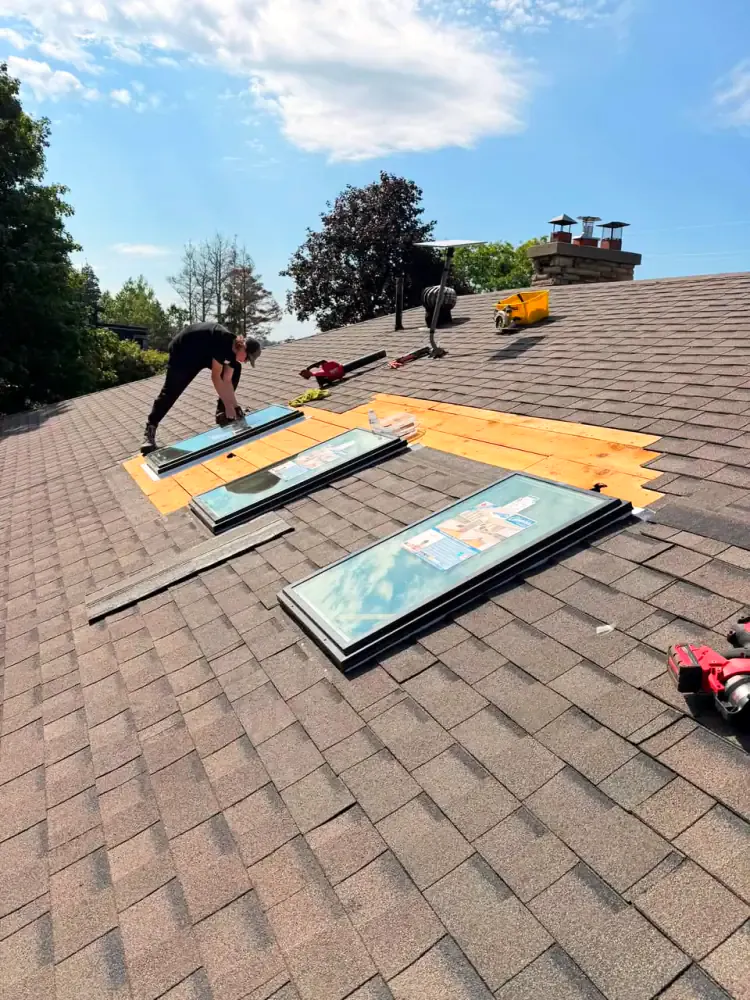
Where skylights actually leak
In practice, water almost always comes in around the skylight rather than through it. The glazing unit is the part most likely to be sound.
- The flashing kit. Manufacturers supply a flashing kit matched to the roof covering, and it is designed to be woven into the shingle courses in a specific sequence. Installed out of sequence, or replaced with a generic bead of sealant, it leaks. This is the single most common cause.
- The curb. On curb-mounted skylights, the timber kerb the unit sits on can rot, particularly if it was never properly flashed or capped.
- The head and side flashing. Water arriving from above has to be diverted around the unit. Head flashing that is too short, or lacks a proper diverter on a wide skylight, lets water pile up against the uphill edge.
- The gasket or seal on the unit. Rubber seals perish with ultraviolet exposure and temperature cycling. On an older unit this is genuine, but it is diagnosed after the flashing is ruled out.
- Failed sealed units. Misting between the panes is a failed double-glazed unit, not a leak. The unit needs replacing; the roof is fine.
- The surrounding roof. Sometimes the skylight is innocent and water entering further up the slope simply runs down and drops at the first obstruction it meets — which happens to be the light shaft. Proper detection catches this.
Deck-mounted and curb-mounted skylights
The distinction matters for repair.
Deck-mounted units sit low to the roof plane, fixed directly to the deck, and rely entirely on their flashing kit for weathertightness. They look better, sit flatter, and are less forgiving of poor installation. On a shallow pitch, a deck-mounted unit with an imperfect flashing kit will find the weakness quickly.
Curb-mounted units sit on a built-up timber kerb that raises them above the roof plane, which gives water a height to climb before it gets in. More forgiving, more visible from the ground, and dependent on the kerb being correctly flashed and capped. On low-slope sections, a curb is effectively mandatory — see flat and low-slope roof repair.
When is replacement better than repair?
Repair is reasonable when the unit is sound and only the flashing or a seal has failed. Replacement starts to make better sense when the skylight is old enough that seals and hardware are failing together, the glazing unit has misted internally, the curb has rotted, or a single-pane unit is causing enough condensation to look like a permanent leak. If the roof covering is due for replacement anyway, doing both at once is almost always cheaper than doing them separately, because the flashing kit has to be disturbed either way.
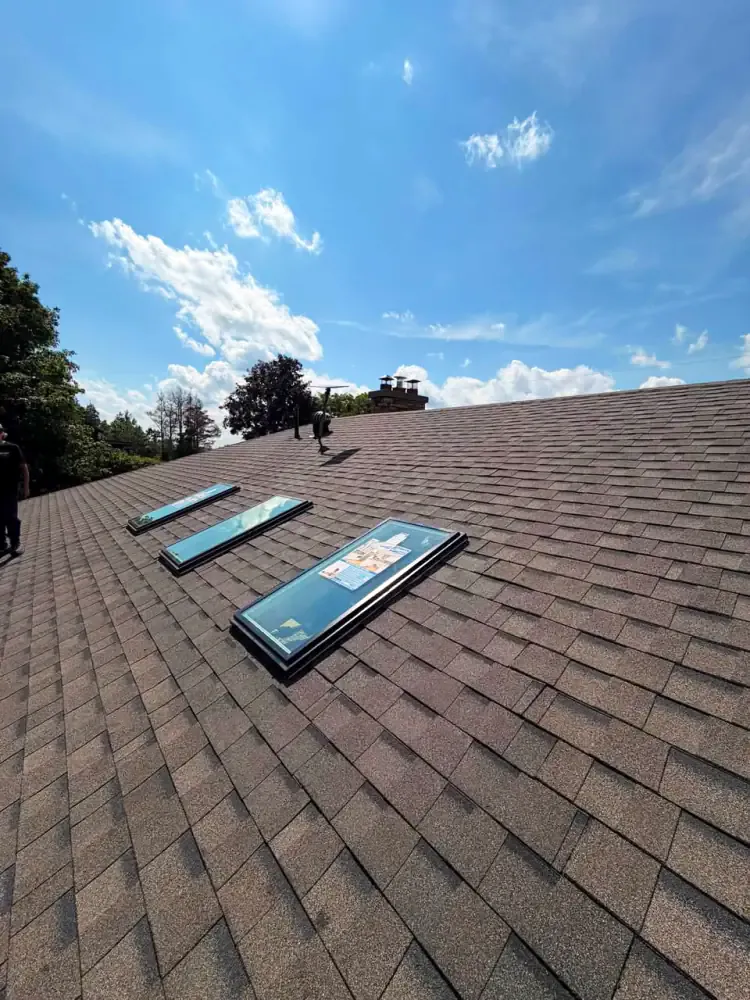
Skylights on Greenville homes
Skylights turn up here in two distinct waves, and they fail differently.
The first is the 1970s to 1990s addition. Dens, sunrooms, kitchen extensions and converted lofts in east-side neighbourhoods such as Foxcroft, Spring Forest and Botany Woods frequently have one or two skylights of that era. Those units are now well beyond the service life of their seals, and many were fitted before modern flashing kits were standard. On these, the honest recommendation is often replacement rather than repeated repair.
The second is the modern renovation. Larger homes in Spaulding Farm, Montebello and Parkins Mill often have newer, better units installed as part of a renovation — sometimes several, sometimes on complex roof planes with valleys and dormers nearby. The units themselves are usually fine; the leaks come from how they interact with surrounding details.
Greenville's tree canopy is the aggravating factor in both cases. Leaves and needles collect on the uphill side of any skylight, exactly where water needs to flow around it. A unit that has a drift of pine needles banked against its head flashing every autumn will leak every autumn, and keeping it clear is genuinely preventive. If you are dealing with a leak you cannot pin down, start with our Greenville roof leak repair service and have the whole slope looked at rather than the skylight alone.
Before you call: what to note down
Skylight leaks are easier to diagnose when you can describe the pattern, so a few observations save time.
- Does it only happen when it rains, or also on cold dry mornings?
- Does wind direction change anything?
- Is the water appearing at the top of the light shaft, the bottom, or one particular side?
- Is there misting between the panes of glass?
- How old is the skylight, and was it fitted at the same time as the roof?
- Has it been repaired before, and with what?
Answering “top edge, only in heavy rain, worse when the wind is from that side” points at head flashing. Answering “all round the inside of the frame, cold mornings, no rain” points at condensation. The difference is the whole job.
Skylight leak questions
Why does my skylight only leak in heavy rain?
Usually because a flashing detail can cope with ordinary flow but not with volume. Head flashing that is slightly too short, or a unit with debris banked against its uphill edge, holds water back until it rises above the flashing upstand. In light rain it drains away; in a downpour it does not.
Is water around my skylight always a roof problem?
No. Condensation on the inside of the glazing is extremely common and is a ventilation and humidity issue, not a roofing one. Misting between the panes means the sealed unit has failed. Both get reported as leaks. Establishing which you have should be the first step.
Can an old skylight be resealed rather than replaced?
Sometimes. If the unit is sound and only the flashing has failed, re-flashing is a legitimate repair. If the seals, hardware and glazing are all ageing together, repeated resealing tends to become an annual expense, and replacement is usually better value.
Should I replace skylights at the same time as the roof?
If they are near the end of their life, yes. The flashing kit has to be disturbed when the roof covering is replaced anyway, so fitting new units then costs much less than doing it as a separate job later. Leaving an old skylight in a new roof is a common false economy.
What is the difference between a deck-mounted and curb-mounted skylight?
A deck-mounted unit fixes directly to the roof deck and sits almost flush, relying entirely on its flashing kit. A curb-mounted unit sits on a raised timber kerb, which gives water further to climb before it can enter. Curb-mounted is more forgiving and is the normal choice on low-slope roofs.
Do skylights always leak eventually?
No, but they are an intentional opening in a weatherproof surface, so they concentrate risk at one point. A correctly installed modern unit with the manufacturer's flashing kit, on an appropriate pitch, kept clear of debris, can go a long time without trouble. Most of the leaks we hear about trace back to installation shortcuts rather than the product.
Skylight dripping?
Have the flashing checked before assuming the unit has failed. Call to reach a Greenville roofing contractor.
Calls may be routed to a participating contractor and we may be compensated for the referral.
Other roof leak services
Skylight leaks are often diagnosed alongside these.
Emergency Roof Leak Repair
Water coming in right now? Emergency tarping, dry-in and same-visit stabilisation to stop the damage spreading.
Read moreStorm Damage Roof Leak Repair
Leaks that started after wind, hail or a summer thunderstorm — including documentation for an insurance claim.
Read moreRoof Leak Detection
Finding where water actually gets in, which is rarely directly above the stain on your ceiling.
Read moreChimney & Flashing Leak Repair
Step flashing, counter-flashing, crickets and chimney crowns — the single most common source of roof leaks.
Read moreFlat & Low-Slope Roof Leak Repair
Ponding water, split seams and failed penetrations on TPO, EPDM and modified bitumen low-slope roofs.
Read moreRoof Shingle Repair
Lifted, cracked, missing and wind-creased shingles, nail pops and exposed fasteners.
Read moreRoof Valley Leak Repair
Where two roof planes meet, water concentrates and debris dams it back under the shingles.
Read moreCommercial Roof Leak Repair
Low-slope commercial roofs, HVAC curbs, drains and the licensing rules that differ from residential work.
Read more