Roof Leak Detection in Greenville, SC
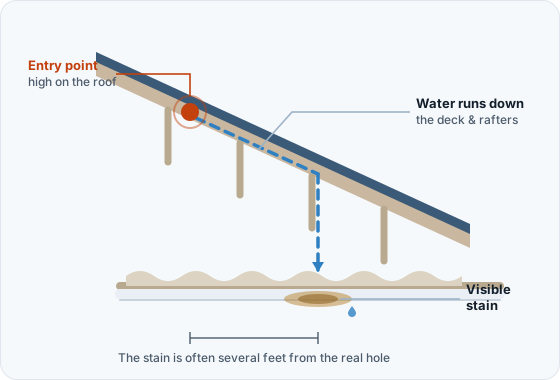
The stain on your ceiling is almost never underneath the hole. Proper leak detection works backwards from the symptom to the source, which is the difference between a repair that holds and a patch that moves the problem.
Greenville SC Roofing Pros connects you with an independent local roofing contractor. We do not carry out roofing work ourselves.
How do roofers find the source of a leak?
By working uphill. Water enters the roof at one point, runs down the underside of the deck or along a rafter, and drops only when something interrupts it. So a roofer starts inside — usually in the attic, with a bright light — finds the wet trail, and follows it up the slope to where it begins. Only then do they go onto the roof, and only then do they know which detail to examine.
The reverse approach, climbing straight onto the roof above the stain and sealing whatever looks suspect, is how leaks get “repaired” twice. On a shallow pitch with a long rafter run, the entry point can be most of a room away from the drip.
What a leak detection visit involves
- A conversation about the symptoms.
When the leak appears, how long it lasts, whether it depends on wind direction, whether it has been repaired before. Wind-dependent leaks point at vertical details such as flashing and siding junctions; leaks in every rain point at horizontal failures in the field or at penetrations.
- Interior and attic inspection.
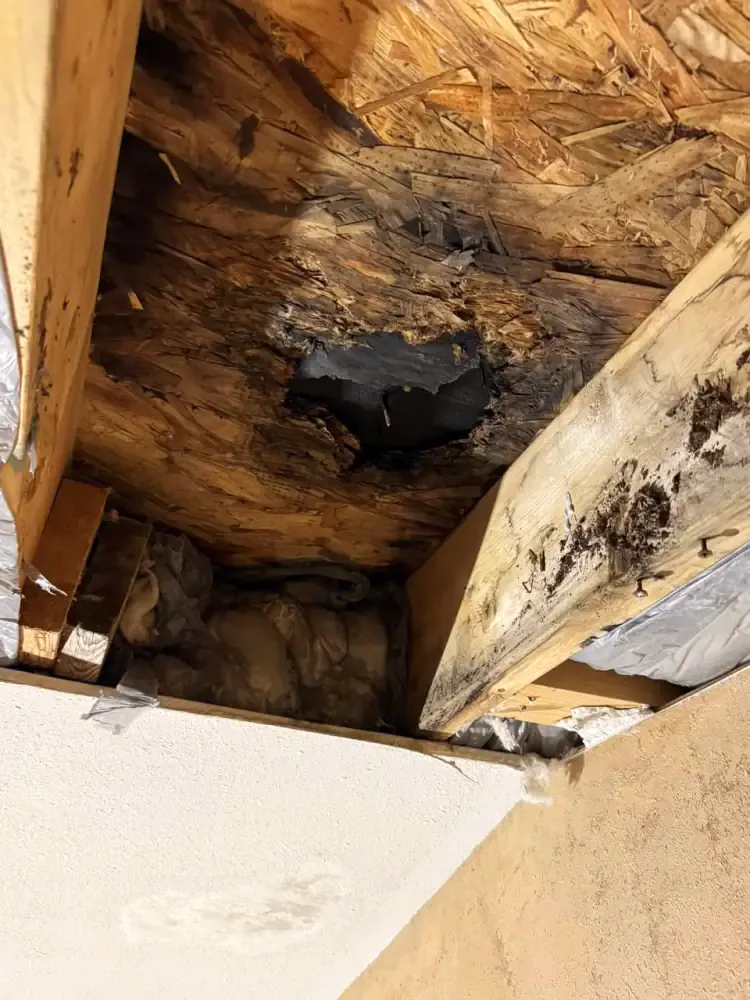
Following the water trail on the underside of the deck and along rafters. Dry staining shows the historic path even when it is not raining. Saturated insulation and darkened sheathing map the extent.
- Moisture measurement.
A moisture meter distinguishes an old, dry stain from an actively wet one — which tells you whether the leak is current or already fixed.
- Roof inspection of the suspect area.
Now targeted rather than speculative: the specific flashing, valley, boot, skylight or shingle course the attic evidence points to.
- A water test if needed.
For stubborn leaks, running a hose on the roof in sections, from the lowest point upward, with someone watching inside. Methodical and slow, but it proves the source rather than guessing it.
- A written finding.
What is leaking, why, what the repair involves, and photographs.
Why the hose test is done bottom-up
If you wet the whole roof at once and water appears inside, you have learned nothing. Starting at the eave and moving up one section at a time, waiting between sections, means that when water finally shows, you know precisely which section caused it.
Things that look like roof leaks but are not
A meaningful share of “roof leaks” turn out to be something else. A detection visit that is worth paying for rules these out rather than assuming the roof is guilty.
| Actually causing it | The tell |
|---|---|
| Attic condensation | Damp spread evenly across the underside of the deck rather than in a trail; worst in cold weather; often traced to poor ventilation or a bathroom fan vented into the attic instead of outside. |
| Bathroom or kitchen exhaust duct | Staining directly around a ceiling fan or near a duct run; appears after showers rather than after rain. |
| Air-conditioning condensate | Appears in hot humid weather with no rain at all; often traced to a blocked condensate line or an overflowing pan in an attic air handler. |
| Plumbing leak | Constant or related to water use rather than weather; may smell different; often directly below a bathroom. |
| Wind-driven rain through siding or windows | Staining at the top of a wall rather than the middle of a ceiling; only with wind from one direction. |
| Ice damming | Only after a freeze; staining near the eaves; an insulation and ventilation problem that presents as a roof problem. |
This is why we treat detection as its own service rather than a free add-on. Correct diagnosis is most of the value, and a contractor who tells you the roof is fine has done you a genuine favour.
Leak detection on Greenville roofs
Two local factors make detection here more involved than it sounds.
The first is tree cover. In neighbourhoods with heavy mature canopy — Alta Vista, Gower Estates, Half Mile Lake — debris collects in valleys and behind chimneys and holds water against the covering. Those leaks are seasonal: fine all summer, leaking every autumn. Diagnosis has to account for that, otherwise the roof passes inspection in July and leaks again in October.
The second is layered history. On older homes in the downtown historic districts, the roof may be on its third or fourth covering, with decking patched by several generations of contractor. Water entering at one point can travel a long way through those layers before it shows. The attic trail is often the only reliable guide, and in houses in East Park or Heritage where attic access is awkward, that takes time.
Intermittent leaks deserve a note of their own. Greenville gets roughly 50 inches of rain a year, mostly in heavy bursts, and plenty of roof details only fail above a certain rainfall rate. A roof that is dry in light rain and leaks in a downpour is not a mystery — it is a detail that cannot cope with volume. Tell the contractor that is the pattern; it narrows the search considerably. Our wider Greenville roof leak repair service covers the repair once the source is confirmed.
When to pay for detection rather than straight repair
- The leak has already been repaired once and came back. The most common reason, and the clearest case for proper diagnosis.
- You cannot see any obvious damage. If the roof looks sound from the ground and nothing is visibly wrong, guesswork is expensive.
- Multiple stains in unrelated places. Either several problems or one problem spreading through the structure — worth establishing which before quoting.
- The leak is intermittent or wind-dependent. These are the hardest to pin down and the easiest to misdiagnose.
- Before buying a house. A stain in an attic during a viewing is worth understanding properly, not negotiating around blindly.
- An insurance claim is involved. Documented cause and effect strengthens the claim.
If, on the other hand, half your pipe boot is visibly split or there is a tarp-sized hole where a limb came through, detection is not the step you need — emergency repair is.
Leak detection questions
Why can't the roofer just look at the roof above the stain?
Because water moves before it drops. It runs down the underside of the deck and along rafters until something stops it, so the entry point is uphill of the stain and frequently several feet away horizontally. Repairing directly above the stain is a guess.
Can a leak be found when it is not raining?
Usually yes. Dry staining on sheathing and rafters records the historic path, a moisture meter distinguishes active wet areas from old dry ones, and a controlled hose test can reproduce the leak on demand. A visit during rain is useful but not essential.
How long does a leak detection visit take?
Straightforward cases are often under an hour. A stubborn intermittent leak needing a staged hose test, or an older house with difficult attic access and several layers of roofing history, can take considerably longer. Ask how it is charged before booking.
Is a roof inspection the same thing as leak detection?
Not quite. A general inspection assesses overall condition and remaining life. Leak detection is diagnostic — it answers one specific question about one specific symptom. They overlap, but if you have an active leak, say so when booking, because the visit is approached differently.
What if the roof turns out not to be the problem?
That is a useful result. Condensation, exhaust ducting, air-conditioning condensate and plumbing all mimic roof leaks, and discovering that the roof is sound saves you from paying for a repair that would never have worked. You would then need the relevant trade rather than a roofer.
Do roofers use infrared or thermal cameras to find leaks?
Some do. Thermal imaging can reveal temperature differences caused by trapped moisture, and it is genuinely useful on low-slope and flat roofs where water spreads under the membrane. It is a supplement to a physical inspection rather than a replacement for one, and it is not available from every contractor.
Leak you cannot find?
Get it traced to the source before you pay anyone to repair it. One call connects you with a Greenville roofing contractor.
Calls may be routed to a participating contractor and we may be compensated for the referral.
Other roof leak services
Once the source is confirmed, the repair usually falls into one of these categories.
Emergency Roof Leak Repair
Water coming in right now? Emergency tarping, dry-in and same-visit stabilisation to stop the damage spreading.
Read moreStorm Damage Roof Leak Repair
Leaks that started after wind, hail or a summer thunderstorm — including documentation for an insurance claim.
Read moreChimney & Flashing Leak Repair
Step flashing, counter-flashing, crickets and chimney crowns — the single most common source of roof leaks.
Read moreFlat & Low-Slope Roof Leak Repair
Ponding water, split seams and failed penetrations on TPO, EPDM and modified bitumen low-slope roofs.
Read moreSkylight Leak Repair
Failed seals, cracked curbs and bad flashing kits — plus telling a real leak apart from condensation.
Read moreRoof Shingle Repair
Lifted, cracked, missing and wind-creased shingles, nail pops and exposed fasteners.
Read moreRoof Valley Leak Repair
Where two roof planes meet, water concentrates and debris dams it back under the shingles.
Read moreCommercial Roof Leak Repair
Low-slope commercial roofs, HVAC curbs, drains and the licensing rules that differ from residential work.
Read more