Roof Valley Leak Repair in Greenville, SC
A valley carries more water, faster, than any other part of your roof. Under Greenville’s tree canopy it also collects more debris than any other part — which is why valleys produce so many of the leaks that only appear at certain times of year.
Greenville SC Roofing Pros connects you with an independent local roofing contractor. We do not carry out roofing work ourselves.
Why do roof valleys leak?
A valley is the internal angle where two roof slopes meet, and every drop of rain landing on both of those slopes drains through it. The water volume is concentrated and it moves fast, so a valley is doing the hardest drainage job on the roof with the least margin for error.
Three things go wrong. Debris dams it. Leaves and pine needles collect in the channel, water backs up behind the dam, and because it is now sitting still rather than running, it works sideways underneath the shingle courses on either side. The lining fails. Open valleys use exposed metal, and older galvanised metal rusts through from the fastenings outward. It was built wrong. Nails driven too close to the centre line, a closed valley woven with the wrong overlap, or an underlayment that stops short all produce a valley that works in light rain and fails in heavy rain.
The tell-tale pattern
If your leak appears in autumn and stops by spring, or only shows up in a genuine downpour and not in steady drizzle, a valley is the first place a good contractor will look. Both patterns point at drainage capacity rather than at a hole.
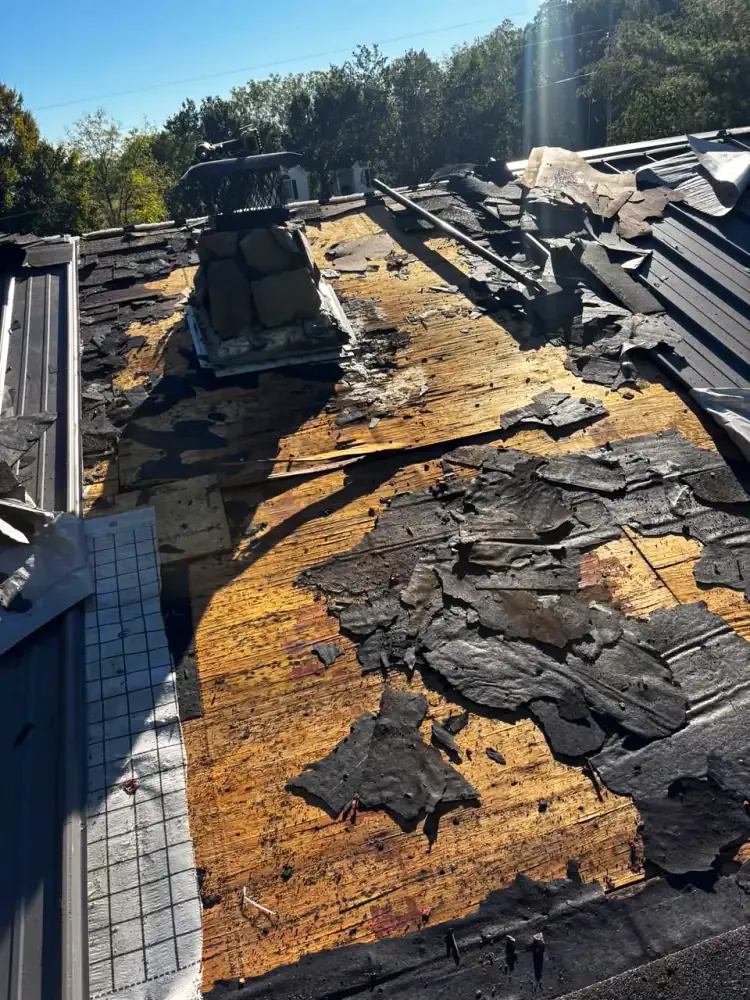
Open, closed and woven valleys
There are three common ways to build a valley, and they fail differently.
| Type | How it is built | How it fails |
|---|---|---|
| Open valley | A visible metal channel runs down the centre; shingles are cut back on both sides to leave it exposed | The metal corrodes, fastenings loosen, or the shingle cut is too close to the centre so water runs over the edge of the metal |
| Closed-cut valley | Shingles from one slope run through the valley; the other slope is cut back over the top | The cut edge sits too close to the centre, or the underlayment beneath is too narrow, so wind-driven water gets past the cut line |
| Woven valley | Shingle courses from both slopes alternate across the valley | Shingles will not lie flat through the weave on architectural profiles, creating gaps; it is also very awkward to repair without disturbing both slopes |
Whichever type you have, the critical detail is what sits underneath. A proper valley carries a wide strip of self-adhering ice-and-water membrane on the deck before anything else goes down. That membrane is the real last line of defence, and on older Greenville roofs it is frequently absent entirely.
Debris is the dominant cause here
This is worth stating plainly because it is so specific to this area. Greenville’s established neighbourhoods are heavily wooded, and the leaf and needle load those trees drop every autumn goes somewhere. Gravity takes it into the valleys.
A valley packed with wet leaf litter stops being a drainage channel and becomes a sponge. Water pools behind it, soaks the shingle edges on both sides continuously, and is pushed laterally under the courses. Over a few seasons the constant damp also rots the decking beneath, which turns a cleaning job into a carpentry job.
The neighbourhoods where we hear about this most are exactly the ones with the best tree cover — Alta Vista, Gower Estates, Foxcroft and Half Mile Lake among them. If you have mature oaks or pines overhanging the roof, clearing the valleys twice a year is the single cheapest piece of preventive maintenance available to you. It costs a fraction of what the resulting repair does.
What a valley repair involves
- Clear and inspect.
Everything comes out of the channel so the lining can actually be seen. A surprising number of “valley leaks” turn out to need nothing more than this.
- Check the metal or the cut line.
Looking for corrosion, holes at fastenings, lifted edges, and shingle cuts that sit too close to the centre.
- Open it up if the lining has failed.
Shingles on both sides are lifted back far enough to expose the full width of the valley.
- Replace the decking if it has rotted.
Common where a valley has been holding water for several seasons. This is the step that moves the price.
- Lay new membrane and new valley metal.
Wide self-adhering underlayment first, then the lining, fastened only at the outer edges so there are no penetrations in the water channel.
- Re-lay the shingles with the correct cut-back.
And hand-seal the tabs that were lifted.
Valleys sit immediately next to other leak-prone details, so it is worth having the whole area assessed at once. Dormer valleys in particular run straight into roof-to-wall flashing, and the two are often repaired together.
When the valley is not actually the problem
Valleys get blamed for a lot of leaks that start elsewhere, because water running down the underside of a deck naturally collects along the valley rafter before it drops. A stain that appears below a valley does not prove the valley is leaking.
This is exactly the situation that a proper leak detection visit exists to resolve — following the wet trail uphill in the attic rather than assuming the nearest suspicious feature is guilty. If a valley has already been repaired once and the leak came back, the likelihood that the original diagnosis was wrong is high.
For the full picture of how we handle roof leak repair in Greenville, SC, start on the main page — it covers the common causes and what drives repair costs.
Roof valley questions
How often should roof valleys be cleared?
Once a year as a minimum, and twice where there is heavy tree cover — after the autumn leaf drop and again in spring. Valleys do not self-clear the way open slopes do, because debris washes into them from both sides and then stays put.
Can a valley be repaired without replacing the whole roof?
Usually yes. A valley is a defined area, and lifting the shingles back on either side to replace the membrane and metal is routine work. The complication is the condition of the surrounding shingles — on a brittle old roof they crack when lifted, which widens the repair considerably.
What is ice-and-water membrane and does my valley have it?
It is a self-adhering waterproof underlayment laid directly on the deck before the valley lining goes down, and it seals around fastenings. It is standard practice now and is often required by code in valleys. On roofs built or re-covered before it became common, it is frequently absent — a contractor will see immediately once the valley is opened.
Is an open metal valley better than a closed one?
Both work when built correctly. Open metal valleys shed debris better and are easier to inspect, which is a real advantage under heavy tree cover. Closed valleys look tidier and hide the metal. Under Greenville's canopy there is a practical argument for open valleys on roofs that collect a lot of debris.
My valley leaks only in heavy rain. Why?
Because the channel can cope with the flow in light rain but not with the volume in a downpour. Once water rises above the lining's upstand or backs up behind a debris dam, it goes sideways under the shingles instead of down the valley. It is a capacity problem rather than a hole.
Leak where two roof slopes meet?
Valleys are the hardest-working part of a roof. Call to reach a contractor covering Greenville and Greenville County.
Calls may be routed to a participating contractor and we may be compensated for the referral.
Other roof leak services
Valley problems usually sit alongside these other details.
Emergency Roof Leak Repair
Water coming in right now? Emergency tarping, dry-in and same-visit stabilisation to stop the damage spreading.
Read moreStorm Damage Roof Leak Repair
Leaks that started after wind, hail or a summer thunderstorm — including documentation for an insurance claim.
Read moreRoof Leak Detection
Finding where water actually gets in, which is rarely directly above the stain on your ceiling.
Read moreChimney & Flashing Leak Repair
Step flashing, counter-flashing, crickets and chimney crowns — the single most common source of roof leaks.
Read moreFlat & Low-Slope Roof Leak Repair
Ponding water, split seams and failed penetrations on TPO, EPDM and modified bitumen low-slope roofs.
Read moreSkylight Leak Repair
Failed seals, cracked curbs and bad flashing kits — plus telling a real leak apart from condensation.
Read moreRoof Shingle Repair
Lifted, cracked, missing and wind-creased shingles, nail pops and exposed fasteners.
Read moreCommercial Roof Leak Repair
Low-slope commercial roofs, HVAC curbs, drains and the licensing rules that differ from residential work.
Read more