Chimney & Flashing Leak Repair in Greenville, SC
Flashing is the metalwork that seals every junction on a roof — chimneys, walls, valleys, dormers. It is where most roofs leak, because it is where most roofs are installed badly or sealed with caulk instead of built properly.
Greenville SC Roofing Pros connects you with an independent local roofing contractor. We do not carry out roofing work ourselves.
What is roof flashing, and why does it leak?
Flashing is sheet metal installed at every point where a roof plane meets something else: a chimney, a wall, a dormer cheek, a valley, a skylight curb. Its job is to carry water back out onto the roof covering instead of letting it run into the junction.
It leaks for three recurring reasons. It was installed badly in the first place — surface-mounted and caulked rather than woven into the shingle courses and let into the masonry. It has reached the end of its life — galvanised steel rusts through, and fasteners corrode. Or the sealant that was doing a job the metal should have been doing has hardened, shrunk and cracked.
The third of those is the one worth understanding. Caulk is not flashing. A correctly built flashing detail sheds water by geometry and overlap, and would still work with no sealant at all. Sealant is a secondary defence. When you see a chimney with a thick bead of mastic smeared around its base, you are usually looking at a repair that has already failed once and is about to again.
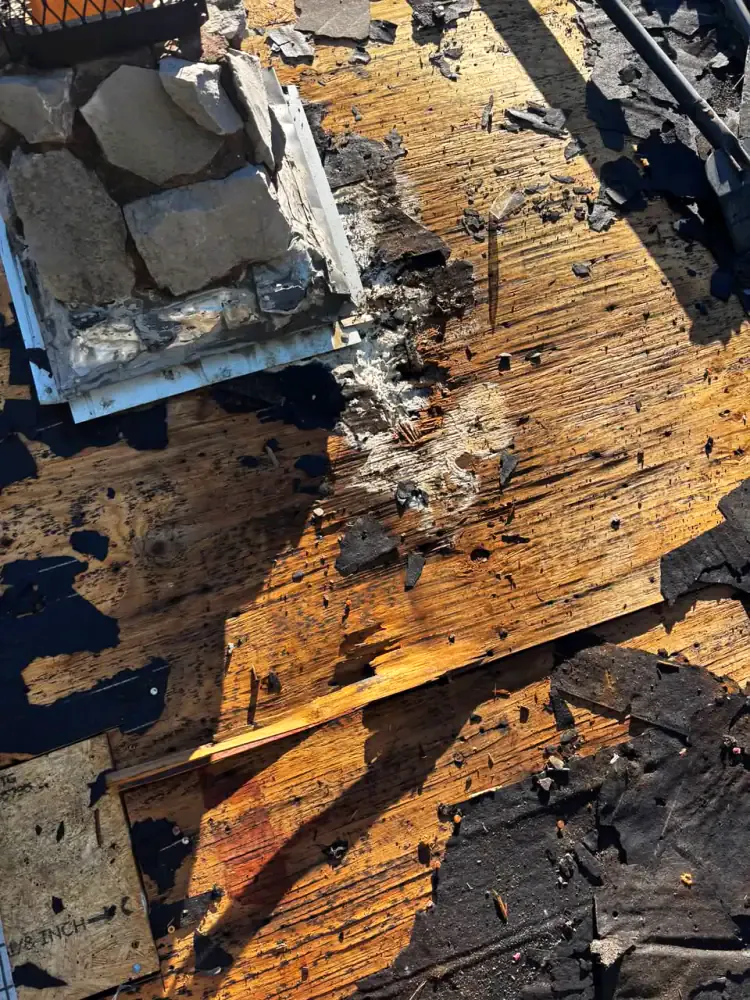
The parts of a chimney flashing system
Chimneys cause more leaks than any other single feature on a roof, because a chimney interrupts the flow of water across a slope and has to be sealed on four sides that each behave differently.
| Component | What it does | How it fails |
|---|---|---|
| Step flashing | Individual L-shaped pieces woven into each shingle course up the sides of the chimney | Replaced with one long continuous strip by someone cutting corners; corrodes; lifts in wind |
| Counter-flashing | Metal let into a mortar joint and folded down over the step flashing | Surface-mounted and caulked instead of let into the masonry; mortar joint erodes; sealant cracks |
| Apron (front) flashing | Carries water arriving from above around the uphill face of the chimney | Too short, or the shingle overlap is reversed |
| Cricket / saddle | A small peaked structure behind a wide chimney that divides water and sends it around both sides | Omitted entirely — very common, and the reason water ponds and backs up behind wide chimneys |
| Chimney crown | The concrete or mortar cap on top of the stack | Cracks, letting water into the masonry so it emerges lower down and looks like a roof leak |
| Masonry itself | Brick and mortar | Porous or spalled brick and failed pointing absorb water directly — a masonry repair, not a roofing one |
This is why a proper repair sometimes involves more than the roofer. If water is getting in through a cracked crown or spalled brick, re-flashing will not stop it.
Wall, dormer and valley flashing
Chimneys get the attention, but the same principles apply everywhere a roof meets something vertical.
Roof-to-wall junctions
Where a lower roof runs into an upper wall — above a porch, a garage, a single-storey extension — step flashing has to run up the wall behind the cladding, and there has to be a kick-out at the bottom to throw water into the gutter. A missing kick-out flashing sends every bit of water running down that junction straight into the wall behind the siding. It is one of the most damaging small omissions in residential roofing, because it rots the wall structure invisibly for years.
Dormers
A dormer creates two valleys and two roof-to-wall junctions in a small area, which is a lot of flashing in a small space. Dormer cheeks in particular are a frequent leak point on the older Greenville houses that have them.
Valleys
Where two roof planes meet, water concentrates and moves fast. Open valleys use exposed metal; closed valleys weave the shingles across. Both work when built correctly. Both leak when debris dams water up and pushes it sideways under the covering — which, in a city with this much mature tree cover, happens routinely.
Flashing problems on Greenville's older homes
Greenville has seven city-recognised historic districts, and flashing is disproportionately where those houses leak. The reasons are structural rather than accidental.
Older homes have more chimneys, and often taller and wider ones — wide enough to need a cricket that frequently was never built. Masonry from that era is softer, so mortar joints erode and counter-flashing works loose. And these roofs have been re-covered several times, with each contractor reusing or surface-mounting the flashing rather than rebuilding it. The flashing in a 1920s house may be older than the shingles above it by several decades.
Districts like Hampton-Pinckney, which became Greenville's first National Register listing in 1977 and its first local preservation overlay district, Colonel Elias Earle, listed on the National Register in 1982, and Pettigru east of downtown all carry an extra consideration: visible exterior changes in a locally designated preservation overlay district can require design review by the city. Flashing repairs are rarely contentious, but a change of material or a visible metal finish may be. Confirm with the City of Greenville before material is ordered.
Flashing failures are not confined to old houses, though. On 1970s and 1980s east-side homes in Foxcroft and Spring Forest, the usual culprit is galvanised flashing that has simply reached the end of its service life, and kick-out flashings that were never installed because the detail was not standard practice when those houses were built. If you are not sure which applies to yours, start with a proper leak detection visit or call about roof leak repair anywhere in Greenville.
What a flashing repair actually involves
Done properly, re-flashing a chimney is not a quick job, and a quote that sounds suspiciously cheap usually means someone is planning to caulk it.
- Shingles around the chimney are lifted and the old flashing removed
- Deteriorated decking underneath is cut out and replaced if found
- New step flashing is woven into each shingle course as it is re-laid
- A slot is cut into the mortar joint, counter-flashing is let in, and the joint is re-pointed
- A cricket is built behind the chimney if the width warrants it and there is none
- Sealant is applied as a secondary defence, not as the primary one
Signs your flashing is the problem
- Staining on a ceiling or wall close to the chimney breast, often in the same spot every year
- The leak is worse in wind-driven rain than in heavy vertical rain
- Visible rust streaks running down from the flashing line
- Thick, cracked beads of old sealant around the chimney base
- Damp at the top of an exterior wall below a roof-to-wall junction — classic missing kick-out
- Crumbling mortar joints or a cracked concrete crown on top of the stack
Flashing and chimney leak questions
Can I just caulk around my chimney to stop the leak?
It may buy a season. It is not a repair. Properly built flashing sheds water through overlap and geometry and would work with no sealant at all; caulk is a secondary defence that hardens, shrinks and cracks. Repeated caulking also makes the eventual proper repair more awkward and more expensive.
What is a chimney cricket and do I need one?
A cricket is a small peaked structure built on the uphill side of a chimney to divide water and send it around both sides instead of letting it pond against the masonry. Wider chimneys generally need one, and building codes commonly require one above a certain width. Many older Greenville chimneys do not have one, and that omission is a frequent cause of persistent leaks behind the stack.
Why does my chimney only leak when the wind blows?
Wind-driven rain is pushed sideways and upward, under shingle courses and behind flashing designed only to shed water running downhill. A wind-dependent leak is a strong indicator that the problem is a vertical junction — flashing, counter-flashing or masonry — rather than the field of the roof.
Is a leaking chimney a roofing job or a masonry job?
It can be either, and sometimes both. Flashing, step flashing and crickets are roofing work. A cracked crown, spalled brick or failed pointing is masonry work. A thorough inspection should tell you which you are dealing with before anyone quotes, because re-flashing will not stop water coming through porous brickwork.
How long should flashing last?
It depends entirely on material and installation. Properly installed copper can outlast several roof coverings. Galvanised steel has a much shorter life and rusts from the fastenings outward. Aluminium sits between the two but reacts badly against some masonry. The bigger variable is whether it was built in or surface-mounted.
What is kick-out flashing and why does it matter so much?
It is a small angled piece at the bottom of a roof-to-wall junction that throws water out into the gutter instead of letting it run down behind the siding. When it is missing, water funnels into the wall cavity every time it rains, and the damage is invisible until the sheathing has rotted. It is a small part responsible for a disproportionate amount of structural damage.
Leak near a chimney or wall junction?
Flashing repairs are worth doing properly once. Call to be connected with a roofing contractor working in Greenville.
Calls may be routed to a participating contractor and we may be compensated for the referral.
Other roof leak services
Flashing problems often sit alongside these other failures on the same roof.
Emergency Roof Leak Repair
Water coming in right now? Emergency tarping, dry-in and same-visit stabilisation to stop the damage spreading.
Read moreStorm Damage Roof Leak Repair
Leaks that started after wind, hail or a summer thunderstorm — including documentation for an insurance claim.
Read moreRoof Leak Detection
Finding where water actually gets in, which is rarely directly above the stain on your ceiling.
Read moreFlat & Low-Slope Roof Leak Repair
Ponding water, split seams and failed penetrations on TPO, EPDM and modified bitumen low-slope roofs.
Read moreSkylight Leak Repair
Failed seals, cracked curbs and bad flashing kits — plus telling a real leak apart from condensation.
Read moreRoof Shingle Repair
Lifted, cracked, missing and wind-creased shingles, nail pops and exposed fasteners.
Read moreRoof Valley Leak Repair
Where two roof planes meet, water concentrates and debris dams it back under the shingles.
Read moreCommercial Roof Leak Repair
Low-slope commercial roofs, HVAC curbs, drains and the licensing rules that differ from residential work.
Read more