Commercial Roof Leak Repair in Greenville, SC
A leak in a commercial building is not just a maintenance problem — it stops work, damages stock and equipment, and creates liability. It also falls under a different South Carolina contractor licence from small residential repairs.
Greenville SC Roofing Pros connects you with an independent local roofing contractor. We do not carry out roofing work ourselves.
How is commercial roof leak repair different?
Three things change once the building is commercial rather than residential.
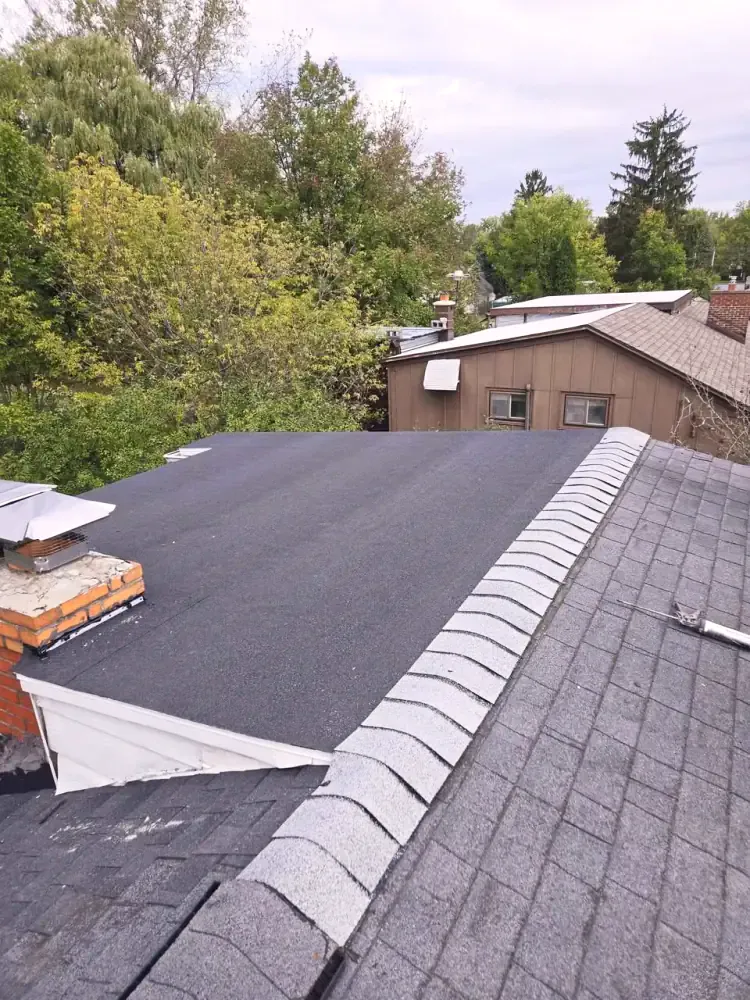
The roof is usually low-slope. Most commercial buildings in Greenville County are flat or near-flat, covered in a single-ply membrane, modified bitumen or a built-up system. These hold water rather than shedding it, so they fail at seams, edges and penetrations instead of in the field. The underlying principles are the same ones covered on our flat and low-slope roof page, applied at larger scale.
There are far more penetrations. Rooftop HVAC units sit on curbs that have to be flashed. Refrigerant lines, condensate drains, electrical conduit, exhaust fans, vents and sometimes satellite or telecoms equipment all pass through the membrane. Every one is a potential entry point, and equipment installed after the roof was built is a frequent culprit.
The licence requirement is different. In South Carolina, commercial roofing requires a general contractor licence carrying a roofing classification, issued through the Contractors’ Licensing Board — not the Residential Specialty registration that covers small residential jobs. It is a fair and specific question to ask any contractor quoting on a commercial property.
Where commercial roofs actually leak
- HVAC curbs. The single most common source. Units are heavy, they vibrate, and the flashing around the curb works loose over time. Units replaced mid-life are often re-set without the flashing being rebuilt.
- Drains and scuppers. Blocked drains cause ponding; failed drain flashing lets water straight into the structure at the lowest point of the roof, where it is under the most pressure.
- Seams. Under-welded or aged seams on single-ply membrane, open laps on modified bitumen.
- Perimeter and edge metal. Where the membrane terminates at a parapet or coping, wind uplift works at the edge continuously.
- Penetrations added later. Conduit, cable and pipe run through the roof after installation and sealed with mastic rather than flashed properly.
- Foot traffic damage. Punctures from service technicians working on rooftop equipment without walkway pads.
Trapped water is the expensive part
On a commercial roof, water that gets through the membrane spreads sideways through the insulation, often across a very large area, before it drops through a deck joint into the space below. By the time a ceiling tile is stained, a substantial amount of insulation may already be saturated. Patching the surface without establishing how far the wet area extends seals the water in and the leak returns.
What a commercial assessment should include
- Interior inspection.
Where water is presenting, what is above it structurally, and what is at risk — stock, equipment, electrical runs, server rooms.
- Roof survey.
Membrane condition, every penetration, drains, edge detail and evidence of ponding.
- Moisture mapping where warranted.
Infrared survey or core samples to establish how far wet insulation extends. This is the step that distinguishes a lasting repair from a recurring one.
- Photographic documentation.
Necessary for insurance, for a landlord-tenant conversation, and for your own records.
- A written scope with options.
Repair, recover or replace, with the reasoning for each.
Repair, recover or replace
Repair makes sense for defined defects on a sound membrane with dry insulation beneath. Recovering — installing a new membrane over the existing one — can be cost-effective when the system is intact but near the end of its life and the structure can carry the extra weight. Full replacement becomes the honest answer when insulation is saturated over a wide area or the deck has deteriorated, and it is also the only option that lets drainage be corrected properly with tapered insulation.
Commercial property in Greenville
Greenville County has a lot of small commercial stock where the roof is the least-considered part of the building: converted houses in professional use, strip retail, light industrial units, and offices built in the 1980s and 1990s that are now well into a second roof cycle.
The Pettigru district is a clear example of the first category. Many of its 88 structures have shifted from residential to professional use, which means original pitched roofs with later low-slope additions, plus mechanical equipment that was never part of the original design. Those buildings leak at the junctions between what was there and what was added.
Weather pressure is the same as on a house but the consequences differ. Severe thunderstorm warnings for this area routinely cite gusts around 60 mph, which lifts perimeter edge metal and membrane edges. Heavy summer downpours overwhelm drains that were marginal to begin with. And the roughly 50 inches of rain Greenville gets in an average year arrives in bursts rather than evenly, which is exactly the pattern low-slope roofs handle worst.
Whether the building is commercial or residential, the route in is the same — describe the property and the symptom and we will connect you with someone appropriate, through the same roof leak repair service covering Greenville.
Practical points before you call
- Know whether you are the owner or the tenant. Responsibility for the roof is set by the lease, and in many commercial leases the structure is the landlord's while interior damage is the tenant's. Establish this before commissioning work.
- Check for an existing roof warranty. Commercial membrane systems frequently carry manufacturer warranties running fifteen or twenty years, and unauthorised repairs by a non-approved contractor can void them. Find the paperwork first.
- Think about access and hours. Roof access, whether work can happen during trading hours, and whether equipment needs isolating.
- Protect what is underneath now. Move stock and cover equipment before anyone arrives. See emergency roof leak repair for what a first visit covers.
- Ask about the licence. Commercial roofing requires a general contractor licence with a roofing classification in South Carolina. You can verify it through the Department of Labor, Licensing and Regulation.
Commercial roof leak questions
Do I need a different kind of contractor for a commercial roof?
In South Carolina, yes. Commercial roofing requires a general contractor licence carrying a roofing classification from the Contractors' Licensing Board, rather than the Residential Specialty registration that covers residential jobs under $10,000. Ask which licence a contractor holds before they quote on a commercial building.
Who is responsible for the roof, the landlord or the tenant?
The lease decides. In many commercial leases the structure and roof are the landlord's responsibility while the tenant covers interior fit-out and contents. Triple-net leases often shift more onto the tenant. Read the relevant clause before you commission work, because it also determines who claims on which insurance.
Will a repair void my commercial roof warranty?
It can. Manufacturer warranties on single-ply systems frequently require work to be carried out by an approved applicator, and repairs by anyone else can void cover that still has years to run. Locate the warranty documentation before authorising anything.
Why is the leak inside nowhere near the damage on the roof?
Because water penetrating a low-slope membrane travels sideways through the insulation layer until it finds a deck joint or fastener to drop through. Lateral travel of many feet is normal, which is why moisture mapping rather than visual inspection is often needed to find the real breach.
Can repairs be done without closing the business?
Usually. Most low-slope repair work happens on the roof rather than inside, and contractors routinely schedule around trading hours. Where the work is directly above an occupied area, or where equipment needs isolating, some coordination is required — raise it when you book so it can be planned rather than discovered.
Commercial roof leaking?
Get it assessed by a contractor licensed for commercial work. One call covers Greenville and the surrounding county.
Calls may be routed to a participating contractor and we may be compensated for the referral.
Other roof leak services
Commercial leaks usually involve these same underlying details.
Emergency Roof Leak Repair
Water coming in right now? Emergency tarping, dry-in and same-visit stabilisation to stop the damage spreading.
Read moreStorm Damage Roof Leak Repair
Leaks that started after wind, hail or a summer thunderstorm — including documentation for an insurance claim.
Read moreRoof Leak Detection
Finding where water actually gets in, which is rarely directly above the stain on your ceiling.
Read moreChimney & Flashing Leak Repair
Step flashing, counter-flashing, crickets and chimney crowns — the single most common source of roof leaks.
Read moreFlat & Low-Slope Roof Leak Repair
Ponding water, split seams and failed penetrations on TPO, EPDM and modified bitumen low-slope roofs.
Read moreSkylight Leak Repair
Failed seals, cracked curbs and bad flashing kits — plus telling a real leak apart from condensation.
Read moreRoof Shingle Repair
Lifted, cracked, missing and wind-creased shingles, nail pops and exposed fasteners.
Read moreRoof Valley Leak Repair
Where two roof planes meet, water concentrates and debris dams it back under the shingles.
Read more