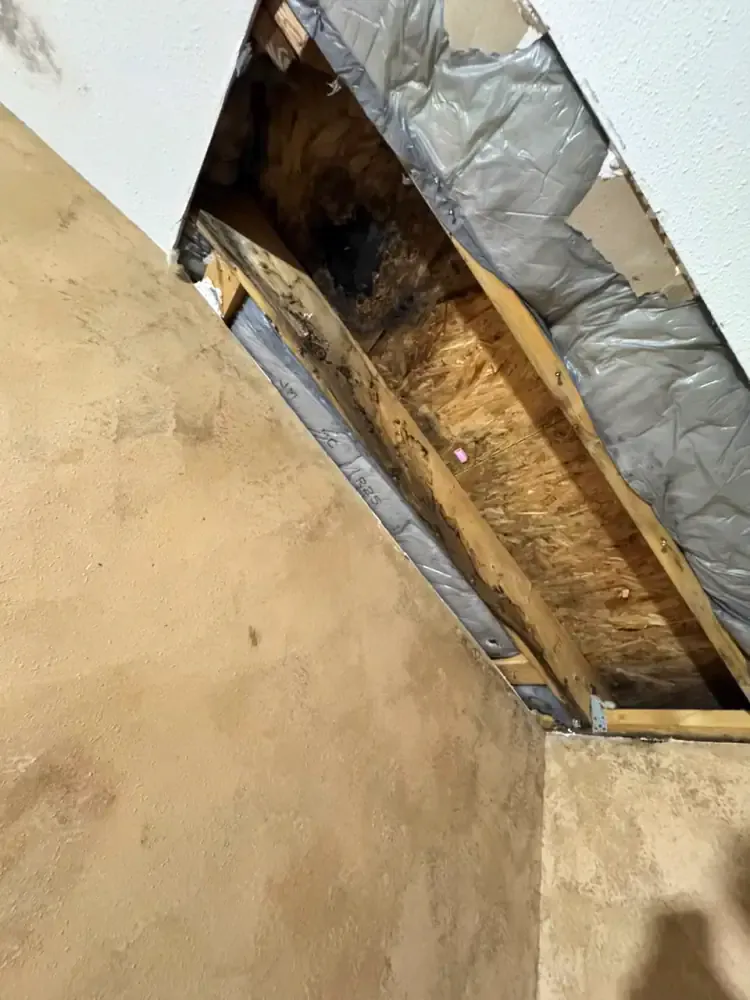
If water is appearing on your ceiling and it has not rained for days, you are dealing with one of a small number of problems — and most of them are not roofing problems. That is genuinely good news, because paying a roofer to repair a roof that is working perfectly is one of the more frustrating ways to spend money on a house.
The useful diagnostic question is not “where is the hole” but “what does this damp correlate with?” Rain, cold weather, hot weather, running the shower, running the air conditioning — each points somewhere different.
The short version: damp that tracks rainfall is a roof problem. Damp that tracks cold weather is condensation. Damp that tracks the air conditioning is a condensate line. Damp that tracks water use is plumbing. Establish the pattern before you call anyone, because it halves the diagnostic work.
1. Attic condensation
This is the most common impostor by a distance, and it is especially common in older Greenville houses where the original construction provided very little attic ventilation.
Warm, humid air from the living space rises into the attic. When it meets the cold underside of the roof deck it condenses, exactly the way a cold drink sweats in summer. Enough of it collects and it drips onto the insulation and eventually through the ceiling below.
How to recognise it: the damp is spread fairly evenly across the underside of the deck rather than running in a defined trail from one point. It is worst in cold weather and has no relationship to rain. You may see frost or beads of water on nail points poking through the sheathing.
What fixes it: ventilation and air sealing, not roofing. Soffit vents that have been blocked by insulation, a missing ridge vent, or a bathroom fan discharging into the attic instead of outside are the usual culprits. It is worth taking seriously — sustained condensation rots decking just as effectively as a leak does, and we see the result on leak detection visits regularly.
2. Air-conditioning condensate
If your air handler sits in the attic — very common in this part of South Carolina — it produces a steady stream of condensate in summer that drains away through a small pipe. When that line blocks with algae or debris, the drain pan overflows.
How to recognise it: it appears in hot, humid weather with no rain at all, and it often stops when the system is switched off. The stain is usually directly below or near the air handler. Many systems have a secondary pan with a float switch that shuts the unit down when it fills, so an air conditioner that keeps cutting out in summer is a strong hint.
What fixes it: an HVAC technician clearing the condensate line. This one costs very little to resolve and a great deal to ignore, because it runs continuously through the cooling season.
3. Bathroom and kitchen exhaust ducts
A bathroom extractor fan moves a large volume of warm, saturated air. If the duct is disconnected, uninsulated or terminates inside the attic rather than through the roof or wall, all of that moisture is being pumped into your roof space several times a day.
How to recognise it: staining concentrated around a ceiling fan or along a duct run, and timing that follows showers rather than weather. An uninsulated metal duct in a cold attic also produces condensation along its whole length, which then drips.
What fixes it: reconnecting, insulating and correctly terminating the duct. Where the duct passes through the roof, the boot around it does need to be properly flashed — which is roofing work, and is covered on our flashing repair page.
4. Plumbing leaks
An obvious candidate that gets overlooked surprisingly often, particularly in two-storey houses where a bathroom sits above the stained ceiling.
How to recognise it: the damp is constant, or it correlates with water use rather than weather. Supply-pipe leaks run continuously; waste-pipe leaks appear when something is drained. The water may smell different, and the stain often has a defined, growing edge rather than the diffuse brown ring a roof leak leaves.
What fixes it: a plumber. Worth saying plainly, because a roofer who finds nothing wrong on the roof has still given you useful information.
5. Wind-driven rain through walls, windows and siding
This one does correlate with rain, which makes it harder to separate from a genuine roof leak — but the water is entering the wall, not the roof.
How to recognise it: staining appears at the top of an exterior wall rather than in the middle of a ceiling, and only when the wind blows from one particular direction. Driving rain is pushed sideways into gaps around window heads, failed caulking, siding laps and the junction where a lower roof meets an upper wall.
That last one is worth dwelling on. Where a garage or single-storey extension roof runs into a two-storey wall, there should be a small angled piece of metal at the bottom called a kick-out flashing, throwing water out into the gutter. On houses built in the 1970s it frequently was not fitted, and without it every drop runs behind the siding. It is a tiny component responsible for a disproportionate amount of hidden structural damage, and it is common across east-side neighbourhoods such as Foxcroft and Spring Forest.
6. Ice damming
Less frequent in the Upstate than further north, but it happens in a hard winter.
How to recognise it: staining near the eaves after a freeze, usually with icicles along the gutter line. Heat escaping into the attic melts snow on the upper roof; the meltwater refreezes at the cold eave; the resulting ridge of ice backs water up under the shingles.
What fixes it: insulation and ventilation, mostly. The roof is the symptom rather than the cause, although self-adhering membrane at the eaves helps on a re-roof.
How a roofer tells them apart
A diagnostic visit worth paying for starts inside, not on the roof. The sequence is usually:
- Questions about the pattern. When it appears, how long it lasts, whether wind direction matters, whether it relates to weather at all.
- Attic inspection. Looking for a defined wet trail running downhill from a single point — which indicates a leak — versus even dampness across the deck, which indicates condensation.
- Moisture readings. Distinguishing an old dry stain from an actively wet one, which tells you whether the problem is current.
- Checking the obvious non-roof suspects. Condensate pan, duct runs, plumbing above.
- A controlled hose test if it still is not clear — wetting the roof in sections from the eave upward, with someone watching inside.
This is the whole method behind roof leak detection, and it is why we treat it as a service in its own right rather than a free add-on to a repair.
When it is the roof after all
Plenty of roof leaks are intermittent in ways that make them look like something else. Greenville gets roughly 50 inches of rain in an average year and most of it arrives in heavy bursts, so a detail that copes perfectly with drizzle can fail completely in a downpour and then look fine again for weeks.
A leak that only shows in heavy rain is not mysterious — it is a drainage or capacity problem, usually a blocked or undersized valley. A leak that only shows in wind-driven rain points at vertical details: flashing, chimney masonry, wall junctions. A leak that appeared weeks after a storm is entirely consistent with wind damage that broke the seal between shingle courses without removing anything.
If water is actively coming in while you read this, the diagnosis can wait — protect the inside of the house first and get the roof stabilised. Our emergency roof leak repair page covers what to do in the first ten minutes. For anything less urgent, describing the pattern accurately is the single most useful thing you can do before calling about roof leak repair in Greenville, SC.